
Measuring Bolt patterns
Measuring Bolt Pattern
What is my bolt pattern and how do I measure it?
Below we explain how you can determine which of the different bolt patterns you need for your trailer or car.
The bolt pattern consists of the number of bolt holes and the diameter of the bolt circle.
Number of bolt holes:
The wheel is fastened by bolts. The number of bolt holes is used in determining the bolt pattern. These can easily be counted on the wheel. The larger center hole is not a bolt hole and therefore does not count towards the bolt pattern. The center hole is the middle hole in the heart of the wheel. It fits around the axle.
Measuring the diameter of the bolt circle:
If you create a circle from the bolt holes, you get the bolt circle. The diameter of this bolt circle is an essential measurement for the bolt pattern. You can measure the diameter of the bolt pattern yourself. The diameter of this circle in millimeters is used for the bolt pattern.
4 or 6 bolt holes:
With a wheel having 4 or 6 bolt holes, you can measure the distance between two opposing bolt holes center to center, this is then the diameter of the bolt circle. A common size is 4x100. This means that 2 opposing bolt holes are 100 mm apart center to center. Therefore, the bolt circle diameter is 100 mm.
5 bolt holes:
With a wheel having 5 bolt holes, it is a bit more complicated. It can be done in two ways:
- The first way is to draw an imaginary circle through the centers of the bolt holes and measure the diameter of this circle.
- The second way, similar to 4 and 6 bolt holes, uses two opposing bolt holes. However, you don't measure center to center, but from the outside of one bolt hole to the center of the opposing bolt hole.
At Masta Aanhangwagens, we recommend using the first method as it is easier in practice.
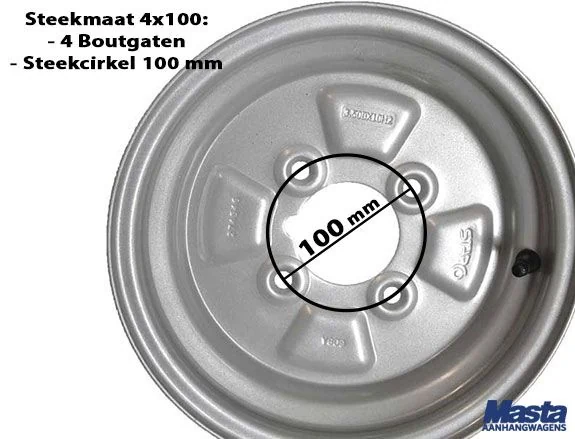
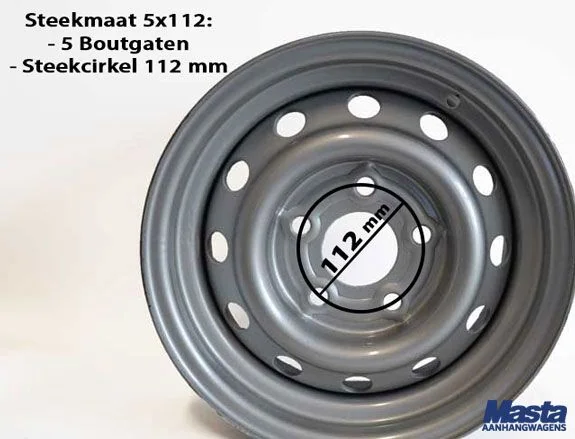
Additional measurements outside the bolt pattern needed for the right wheel selection:
Notation and reading the dimensions of a complete wheel, rim, and tire
The dimensions of a tire and rim are partially displayed on your tire and rim. However, reading them is not always easy. In our titles, we use the display that you can also find on your tire and/or rim. Based on the titles of our products, we will explain the dimensions and notations you may encounter and where to find them. The sizes in the titles are also the ones that are important when choosing the correct rim with tire. The description of all tires on rims shows more detailed specifications. Below you will first see an example title followed by an explanation.
Example title for explanation: Tire on rim 140/70R12 67/112/5/20 86N
Example bolt pattern:
In the example above, the numbers 112/5 are important for the bolt pattern. In this example, there are five bolt holes and the diameter of the bolt circle is 112. In other words, 112/5 or 5x112. A bolt pattern of 112/5 means that the rim has 5 bolt holes. In this example, the diameter of the bolt circle is 112 mm.
Rim diameter:
The rim diameter is always displayed in inches after the tire type. In the example above, it is 12 inches, you can find this after R of radial tire (Radial tire R is the tire type in this case).
The rim diameter is always shown on both the rim and the tire. On the tire, you will find the rim diameter right after the tire type or if the tire type is not mentioned, right after the tire height.
ET value:
A rim consists of two parts. The part where the outer tire is mounted, the outer edge as it were. And you have the disk in the middle of the rim that attaches the rim to the trailer. When the disk is exactly in the center of the rim, the ET value is 0, the rim is then mounted exactly at the midway point of the rim to the trailer.
In the above example, the ET value is 20. This means that the disk is positioned further out compared to the centerline of the rim. The further out the mounting disk is, the further the rim with the tire falls into the wheel arch of the trailer. In the example, the rim (and the tire) falls inward by 20 mm.
The ET value can often be read on the rim. It is displayed in millimeters.
Hub hole diameter:
The hub hole is the middle space of the heart of the rim, the middle hole in the rim. It fits around the axle. The diameter of the hub hole is displayed in millimeters. In the example above, the hub hole is 67 mm.
You can easily measure the diameter yourself with a caliper.

Cargo version:
In some cases, you will find a C after the rim diameter. This means that this tire on rim has extra load capacity. The C in this case stands for cargo version.
Rim model:
In a few cases, you will find the rim model in the title. By default, the rims on our website are steel rims, unless stated otherwise.
Bolt pattern:
The bolt pattern is a combination of the number of bolt holes and the bolt circle diameter. You can easily measure this yourself as mentioned above.
Within the trailer industry in Europe, we often encounter the following bolt patterns:
- 4x100, 4x130, and 5x112, the German bolt patterns.
- 4x115, the French bolt pattern.
- 4x139.7, English bolt pattern.
Flange profile:
The flange profile, also known as flange edge, rim bed shape, or horn code, can have slight differences. Although you can use both rims for your trailer, you cannot always put the same tire on these rims. The image below shows the differences in a "B" and "J" profile.

Difference between "B" and "J" flange edges, rim width 6 inches.
Rim width:
You can also find the rim width on the rim. The rim width is displayed in inches. On the rim, you will find, for example, 5.5J. Here, 5.5 is the width measurement of the rim. The rim width is the distance between the raised rim edges. J in this case refers to the flange profile, the shape of the rim bed. The width of the rim is often referred to as the J-size. In fact, the J here has nothing to do with the width of the rim, but it is the shape of the rim bed.
Profile cross-section:
The profile cross-section of rims is usually placed at the end of the letter and number code, for example, "H2". To achieve the desired rigidity of the rim, manufacturers use "humps" in the construction. These are precisely measured deformations to make the rim stronger and stiffer. In the table below, you will find the different "humps" that may apply to your rim.

Customer Service:
Do you have questions about the different bolt patterns or are you unsure about your bolt pattern? Please contact our customer service. We are happy to help you find the right rim or wheel!